Nevada Leads the Nation in Job Growth: What It Means for Las Vegas Housing

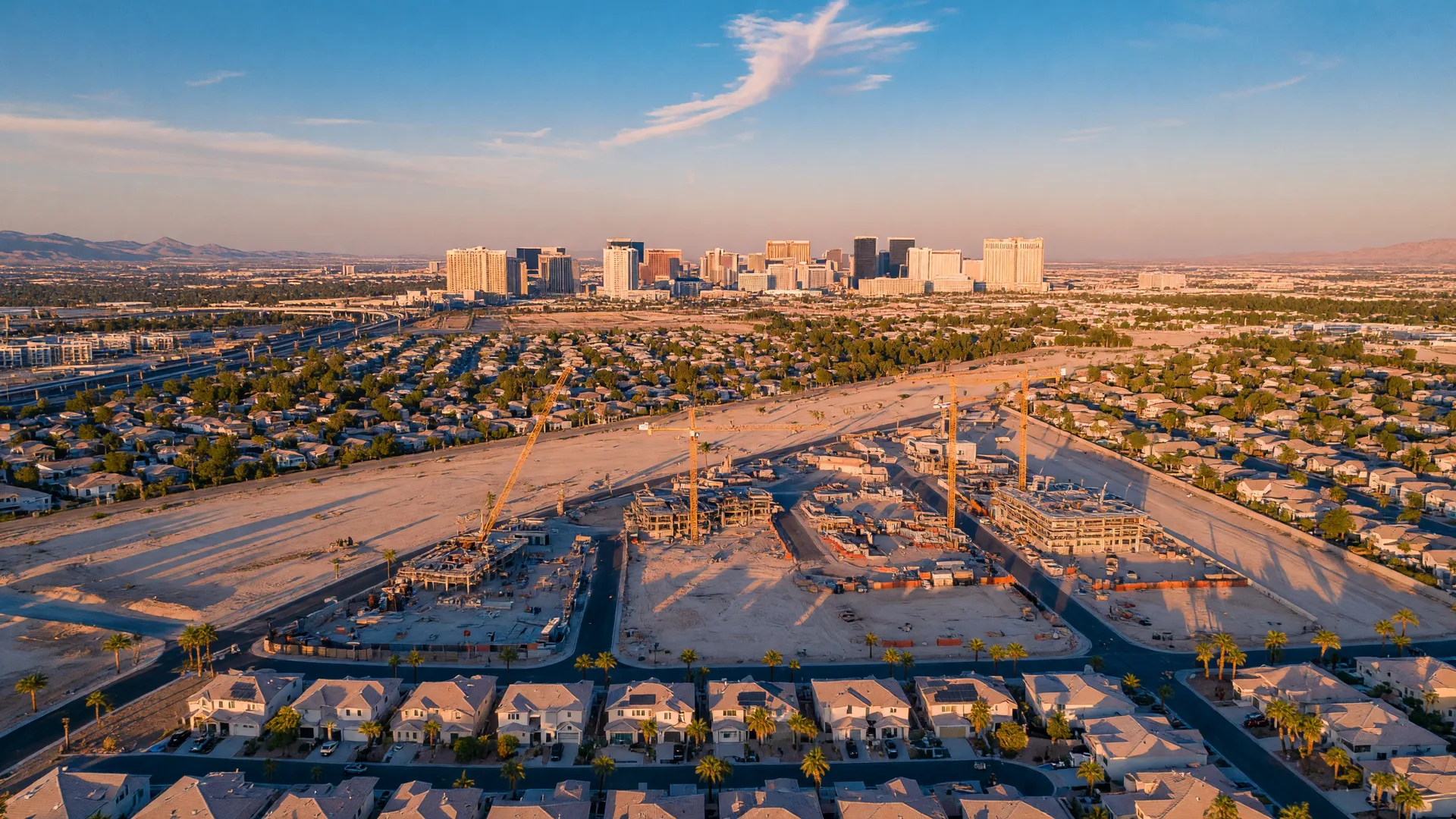
If you follow the Las Vegas housing market closely, you know that inventory, interest rates, and median prices get most of the headlines. Those are important signals, no question. But there is one number that I watch even more closely than any of them because it tells me where the market is headed six to twelve months out: employment.
Jobs create housing demand. It is that simple. When people have steady income, they rent apartments, buy homes, and invest in property. When a metro area adds tens of thousands of new jobs in a single year, the ripple effect on housing is both predictable and profound. And right now, no state in the country is adding jobs faster than Nevada.
The Headline Number That Demands Your Attention
According to data from the Bureau of Labor Statistics and the Nevada Department of Employment, Training, and Rehabilitation, Nevada added 34,500 jobs from February 2025 to February 2026 — a growth rate of 2.2 percent. That is more than double the rate of the second-fastest state in the nation. Nevada has now led the country in job growth for nine consecutive months.
Let me repeat that for anyone who still thinks of Las Vegas as a market that rises and falls exclusively with the tourism cycle: the state with the fastest-growing employment in America is not Texas, not Florida, not Arizona. It is Nevada. And the engine of that growth is the Las Vegas metro area, which reached a record employment level of 1,178,100 jobs in June 2026 — up 25,600 positions from the same month a year earlier.
These are not seasonal hospitality positions filled and emptied with every convention calendar. The growth is concentrated in sectors that pay above-median wages and create durable, year-round employment.
Nevada added 34,500 jobs in one year at a 2.2% growth rate — more than double the rate of the next-fastest state and the top job growth rate in the nation for nine straight months.
Where Are the Jobs Coming From?
One of the most encouraging developments in the Las Vegas economy is how diversified the job market has become. While hospitality and gaming remain the largest employment sectors, the growth story of 2025 and 2026 is being written by industries that barely registered in the valley's economy a decade ago.
Technology: Las Vegas tech employment has grown 4.2 percent annually, the fastest rate in the country. The average tech salary in the valley now exceeds $90,000 per year. Companies are drawn by Nevada's business-friendly tax environment, growing talent pool, and quality-of-life advantages. The LVGEA's three-year strategic plan, launched in 2025, specifically targets technology as one of five key industries for economic diversification.
Healthcare: The expansion of the Las Vegas medical district and the development of new hospital facilities across the valley have created thousands of high-wage healthcare positions. As the population ages and grows, healthcare employment continues to be a steady, non-cyclical driver of demand.
Logistics and Distribution: The Apex Industrial Park in North Las Vegas and the growing warehouse and distribution infrastructure throughout the valley have made Las Vegas a critical logistics hub for the Western United States. The Interchange Industrial Center alone added nearly 700,000 square feet of warehouse space in 2025.
Construction: With over $30 billion in active or planned construction projects — including the Brightline West high-speed rail, the Oakland A's ballpark, the Hard Rock transformation of The Mirage, and the Sphere — Clark County now employs approximately 85,000 construction workers, up 4.9 percent year-over-year.
Professional and Business Services: Financial services, corporate headquarters, and back-office operations are increasingly choosing Las Vegas over traditional markets like Los Angeles, San Francisco, and Chicago. CNBC recently reported that Nevada's workforce grew 1.9 percent from April 2025 to April 2026 — the highest of any state.
What Record Employment Means for Housing Demand
Every new job creates a new household. Some of those households rent, some buy, and some arrive as dual-income households already qualified for homeownership. But in every case, the addition of well-compensated workers to the local economy translates into housing demand somewhere in the market.
Let me give you the math. Twenty-five thousand new jobs in the Las Vegas metro area over the past twelve months, with an average household size of roughly 2.5 people, means approximately 62,500 new residents have joined the valley. Even if half of them already lived here and simply changed jobs, the net in-migration still represents thousands of new households that need housing.
This is why, despite the headlines about rising inventory and longer days on market, prices in Las Vegas have not collapsed. Inventory has grown from historic lows to a more balanced 2.6 to 4.6 months of supply, but demand from the growing employment base has absorbed the additional supply without triggering a price correction.
In Henderson, where new master-planned communities like Cadence and Meriden continue to expand, the demand from the tech and logistics sectors is particularly visible. In Summerlin, where the average home price exceeds $700,000, employment growth in financial services and professional services is supporting buyer activity at a level that would surprise anyone who only reads national headlines.
And in Centennial Hills and the northwest valley, the combination of new construction and affordable entry-level pricing is creating opportunities for first-time buyers — many of whom are employed in the very sectors that are driving the valley's growth.
National Recognition Confirms the Trend
The data is not just showing up in state labor reports. CNBC published an article in June 2026 titled "Struggling to find a job? Try looking in Nevada," highlighting the state's workforce growth of 1.9 percent — the highest in the nation. An 8 News Now analysis called Nevada's job growth rate the top in the country, citing Governor Lombardo's economic development policies.
Fox5 Vegas reported in May that Nevada had led the nation in job growth for nine consecutive months, a streak that shows no immediate signs of ending. The consistency of the growth — month after month, across multiple sectors — is what separates this cycle from the post-pandemic bounce we saw in 2021 and 2022.
That bounce was a recovery. This is a structural shift.
The $30 Billion Question
The megaprojects reshaping the Las Vegas skyline are not just tourist attractions. The Brightline West high-speed rail connecting Las Vegas to Southern California — a $12 billion investment — will eventually bring thousands of daily commuters, business travelers, and weekend visitors who can now consider Las Vegas as a primary residence while maintaining professional ties in Los Angeles.
The Oakland A's ballpark represents a $1.75 billion commitment to the valley's future as a major-league sports market. The Vegas Loop, the Sphere, the Hard Rock tower, and dozens of other projects collectively represent over $30 billion in capital investment. Every one of those dollars flows through contractors, suppliers, and workers — and eventually into the housing market as those workers establish households.
The LVGEA's strategic plan, which targets manufacturing, financial services, technology, healthcare, and logistics as the five pillars of a diversified Las Vegas economy, is already producing results. In November 2025 alone, four companies announced more than $9.2 million in capital investment and nearly 325 new jobs in Southern Nevada. That pattern has continued through 2026.
Las Vegas reached a record employment level of 1,178,100 jobs in June 2026, up 25,600 positions year-over-year. Over $30 billion in active construction is reshaping the valley's economy.
What This Means for Buyers
If you are considering buying a home in Las Vegas, the job growth data should give you confidence about the long-term trajectory of your investment. Homes purchased today are being bought into a market with structural demand drivers that extend well beyond any single month's inventory report.
Yes, interest rates remain elevated at around 6.25 to 6.94 percent for a 30-year fixed mortgage. Yes, inventory is higher than it was a year ago, which means sellers are less likely to see multiple offers on day one. But those conditions — higher rates and more choices — create a window for buyers who are willing to act while the market is balanced rather than frenzied.
The risk of waiting is that employment growth continues to outpace housing supply, which it almost certainly will. Clark County's planning commission approved six new neighborhoods totaling hundreds of homes in 2025, and builders delivered over 12,500 single-family new-builds in 2025 — the highest since 2007. But population growth at 1.37 percent annually in the metro area means supply will remain tight relative to demand in the most desirable submarkets.
In practical terms, this means buyers in Summerlin, Henderson, and the southwest valley should be prepared to move quickly when they find the right property. Homes in the most desirable school districts and master-planned communities are still receiving multiple offers, especially at price points that reflect current market conditions rather than 2021 peak pricing.
What This Means for Sellers
For sellers, the job growth data is a double-edged sword. On one hand, the influx of well-compensated workers means the buyer pool is larger and more qualified than it has ever been. On the other hand, those buyers are educated, price-conscious, and willing to walk away from a property that does not meet their value expectations.
The sellers who succeed in this market are the ones who price their homes based on recent comparable sales, not on what the neighbor's house sold for in 2022. They stage their properties professionally. They invest in professional photography and virtual tours. They market to a national audience, not just the local MLS.
That last point is critical. My partnerships with Zillow, HomeLight, Veterans United, Google, and Dave Ramsey's referral network give every listing I take visibility to more than 42 million qualified buyers. In a market where 25,000 new jobs are bringing new people to the valley, that national reach is not optional — it is the difference between a 30-day sale and a 90-day price reduction.
The Bottom Line
The Las Vegas housing market in August 2026 is supported by the strongest employment fundamentals in the country. Nine straight months of leading the nation in job growth. A record 1,178,100 jobs in the metro area. Economic diversification that is reducing the valley's dependence on tourism. Over $30 billion in infrastructure investment that is creating jobs and attracting new residents.
These are not speculative trends. They are real, measurable, and ongoing. For buyers, the message is clear: the conditions for long-term appreciation are in place, and waiting for a market that looks like 2019 or 2020 is a strategy that will cost you. For sellers, the message is equally clear: the demand exists, but it has to be earned through disciplined pricing and professional marketing.
I have watched this market through the dot-com bubble, the 2008 crash, the post-pandemic frenzy, and every cycle in between. I have never seen employment fundamentals as strong as they are today. That does not mean prices will go up in a straight line — they never do. But it does mean that the long-term trajectory of the Las Vegas housing market is firmly positive.
If you have questions about how the current job market is affecting home values in your specific neighborhood — whether you are in Summerlin, Henderson, Centennial Hills, or anywhere in the valley — I would welcome the opportunity to discuss it. Thirty years of experience means I have seen what happens when employment leads and housing follows. Right now, both are moving in the same direction.
For Agent Image / WordPress (tmtluxury.com)
Nevada's #1 Job Growth Streak: How 34,500 New Jobs Are Fueling Las Vegas Housing Demand
Nevada has led the nation in job growth for nine straight months. Record employment, tech expansion, and $30B in construction are reshaping the Las Vegas housing market.
/nevada-job-growth-las-vegas-housing-2026
Different phrasing and unique slug avoid duplicate SEO penalties when cross-posted to tmtluxury.com.
For Lofty CRM
Vegas Just Led the Nation in Job Growth Again
34,500 new jobs. Nine months straight at #1. Here is what record employment means for Las Vegas home values in 2026.
/vegas-job-growth-housing-2026
Shorter, brand-forward title and description optimized for Lofty blog posts that double as email drip content.
Over 30 years of Las Vegas real estate experience. Master Certification in Negotiation. Strategic partnerships with Zillow, HomeLight, Veterans United, Google, and Dave Ramsey's referral network. Las Vegas, Henderson, Summerlin, and Centennial Hills.
Full Bio
Want to know how job growth is affecting your neighborhood?
Javier tracks employment data as closely as home prices. Schedule a consultation to discuss what the job market means for your next move in Las Vegas, Henderson, Summerlin, or Centennial Hills.
Talk to Javier