Las Vegas Home Prices Pull Back from Record High as Inventory Swells to 3.6 Months

The July 2026 housing data is out, and it tells a story that every Las Vegas buyer, seller, and investor needs to understand. For the first time in months, we are seeing measurable pullback from the record highs the market set this spring. But the story is not as simple as "prices are falling." The reality is more layered, and for the people who take the time to understand it, that complexity creates real opportunity.
Let me walk through the numbers, what they mean, and why I believe the Las Vegas housing market is entering one of the most interesting phases I have seen in my 30 years in this business.
The July Numbers: A Market in Transition
According to the Las Vegas Realtors association, data published by the Las Vegas Review-Journal on August 6, 2026, the July market delivered the following headline figures:
- Median home price: $480,000 for previously owned single-family homes, down $10,000 from the record $490,000 set in both May and June 2026. That is a 2 percent month-over-month decline and a 1 percent year-over-year decrease.
- Homes sold: 2,046 single-family homes, up 1.2 percent compared to July 2025. Including condos and townhomes, total sales reached 2,587 units.
- Inventory: 3.6 months of supply, up 2.9 percent year-over-year and up 17.2 percent from June alone. There were approximately 5,687 single-family homes on the market in late July, a 17.7 percent increase from the 4,748 homes listed on January 1, 2026.
- Condos and townhomes: Median price of $290,000, flat year-over-year and down from the record $315,000 set in October 2024. Sales of 541 units.
On the surface, this looks like a market that is softening. Prices are off their highs. Inventory is piling up. The months of supply has crossed from seller territory into the balanced range, with some analysts expecting it to approach four months by late summer.
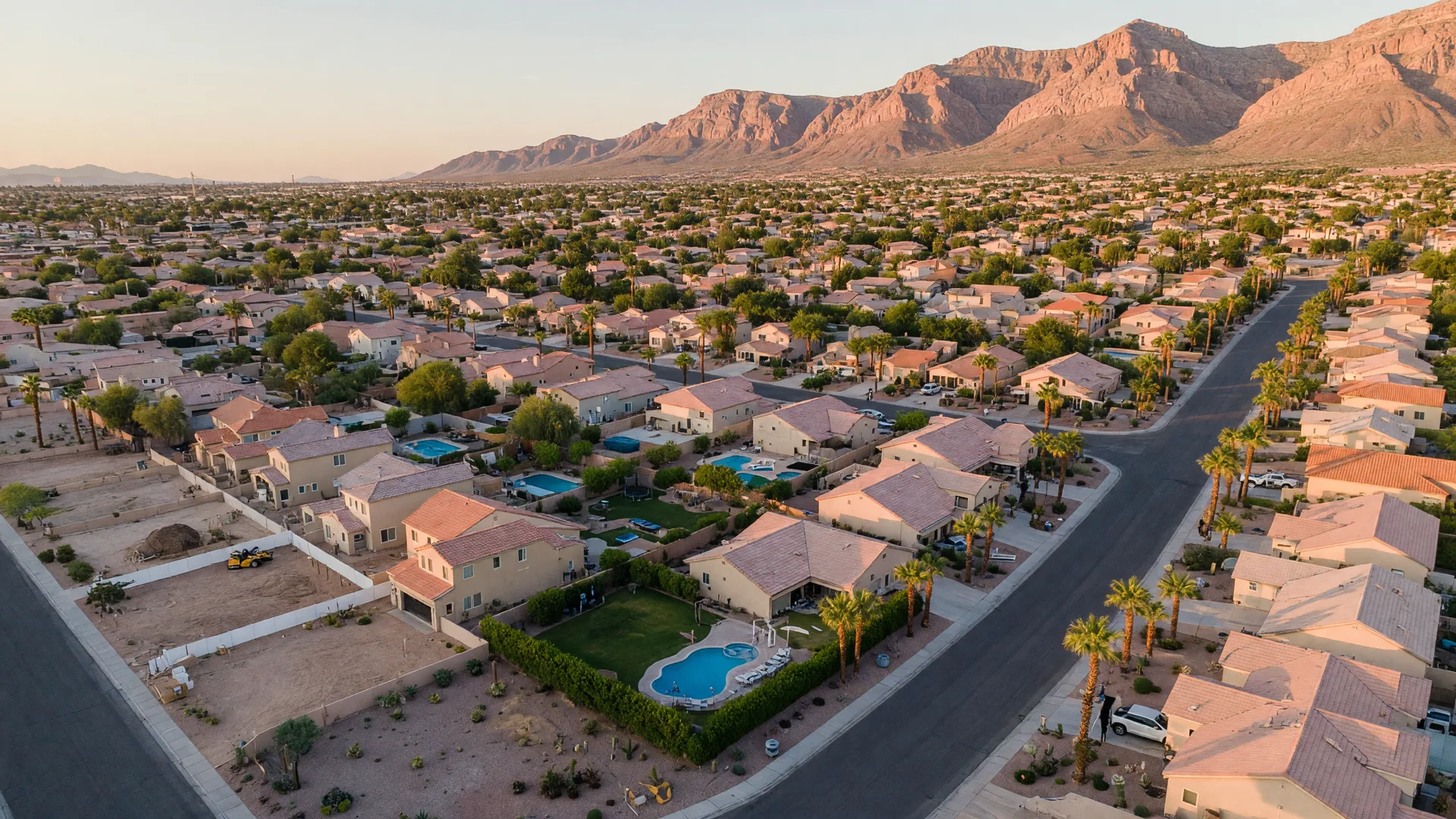
Las Vegas home prices dipped to $480,000 in July 2026, down 2% from the record high. Inventory surged to 3.6 months of supply with over 5,600 single-family homes available.
But here is what the headline numbers do not tell you: 56.8 percent of homes that sold in July went under contract within 30 days. In a market with 3.6 months of supply and 43.4 percent of listings carrying at least one price reduction, more than half of the homes that actually sold moved quickly. That is not a market in freefall. That is a market where the gap between well-priced, well-marketed homes and overpriced, poorly presented listings has widened into a canyon.
Why Aren't Prices Dropping Faster?
The Las Vegas Review-Journal asked exactly this question in a July 28 article titled "Why Aren't Home Prices Dropping in Las Vegas?" It is a fair question. With inventory climbing as fast as it has, and mortgage rates stuck in the 6.5 to 6.7 percent range, a conventional read would suggest prices should be under heavier downward pressure.
The answer comes down to three forces that are acting as a floor beneath the market.
First, employment. As I discussed in my previous post, Nevada has led the nation in job growth for nine consecutive months and counting. The Las Vegas metro area hit a record 1,178,100 jobs in June. Twenty-five thousand new jobs year-over-year means twenty-five thousand new paychecks entering the local economy. Those paychecks translate into housing demand that absorbs inventory before it can snowball into a glut.
Second, limited distressed inventory. In previous downturns, falling prices were driven by a wave of foreclosures and short sales. That is not happening today. The vast majority of Las Vegas homeowners have fixed-rate mortgages at rates below 5 percent. They have equity. They are not desperate to sell, and they are not defaulting. The listings hitting the market are almost entirely discretionary — sellers who want to move, not sellers who have to move. That distinction matters because discretionary sellers can wait. They can price high, test the market, and if they do not get their number, they can pull the listing and sit tight.
Third, the mix effect. The median price is a statistical artifact that can move up or down based on what mix of homes sold in a given month, not because individual home values changed. If more entry-level homes closed in July than luxury properties, the median gets pulled down even if every individual home sold at or above its list price. Given the broader affordability constraints buyers face at current rates, it is entirely possible that the price decline is partly compositional rather than a pure value decline.
The Price Cut Story: A Signal Worth Watching
One number in the July data deserves special attention: 43.4 percent of active listings had at least one price reduction. That is a high figure by historical standards, and it tells me two things.
First, a significant number of sellers are pricing based on what they want, not what the data says. They look at what the neighbor's house sold for in 2022 or 2023, they add a premium for improvements they have made, and they list at a number that the current market will not support. After 30 to 60 days of no offers, they cut the price. Sometimes by $10,000. Sometimes by $50,000. By the time the price reaches market reality, they have lost the crucial first weeks of buyer attention and their listing carries the stigma of a price reduction.
Second, the fact that homes are cutting prices and then selling tells me the demand is there at the right price point. This is not a market where buyers have disappeared. It is a market where buyers are disciplined, informed, and unwilling to overpay in a rising-inventory environment.
43.4% of active listings carried at least one price cut in July, yet 56.8% of homes that sold went under contract within 30 days — the demand exists at the right price.
For buyers, this creates a clear playbook. Target listings that have been on the market for 30 to 60 days. Look for recent price adjustments. Come in with a well-researched offer that reflects the current comparable sales, not the original list price. In a market where inventory is rising and motivated sellers are out there, a prepared buyer has negotiating leverage they have not had since 2019.
What 3.6 Months of Supply Actually Means
Real estate professionals generally use months of inventory as a shorthand for market balance. Less than three months is a seller's market. Three to five months is balanced. More than six months is a buyer's market.
At 3.6 months, Las Vegas is technically balanced — leaning toward a buyer advantage in segments where inventory is highest. But that aggregate number hides significant variation within the market.
In the luxury segment, where months of supply has been running well above four months for much of 2026, buyers have considerably more leverage. Sellers of homes priced above $1 million are facing longer days on market, more price adjustments, and fewer qualified buyers. The oversupply dynamics in luxury that I have written about throughout the spring and summer remain in full effect.
In the entry-level and first-time buyer segments, inventory is much tighter. Homes priced between $300,000 and $450,000 are still receiving multiple offers in many neighborhoods, especially when they are in good condition and correctly priced from day one. The buyer who is looking in Summerlin or Henderson at the higher end of the market will have a very different experience than the first-time buyer looking in the northwest valley or North Las Vegas.
The lesson here is the same one I have been emphasizing all year: the Las Vegas market is not a single market. It is a collection of submarkets defined by price point, geography, condition, and price strategy. The aggregate data tells you the direction of the wind. The local data tells you how to navigate it.
Mortgage Rates: The 6.55 Ceiling
Mortgage rates have settled into a range of roughly 6.25 to 6.55 percent for a 30-year fixed conventional loan, depending on the lender, the borrower's credit profile, and the type of property. That is down from the 7 percent peak in early 2025 but still high enough to constrain purchasing power for a meaningful portion of the buyer pool.
At a 6.55 percent rate, the monthly payment on a $480,000 home with 20 percent down is approximately $2,440 before taxes, insurance, and HOA fees. That payment is about $200 more per month than the same home would have cost at the 5.5 percent rates available in late 2024. For a household earning the Las Vegas median income of roughly $70,000, that $200 difference is the line between qualifying for a loan and being priced out.
This is the central tension in the market right now. Job growth is bringing more people to the valley with more income. But elevated rates are keeping a segment of those potential buyers on the sidelines — renting, saving, waiting for rates to drop or prices to correct further.
The question nobody can answer with certainty is which force wins. If rates drift lower toward 6 percent in the second half of 2026, as some forecasts project, the pent-up demand from sidelined buyers could absorb the current inventory surplus relatively quickly. If rates hold at current levels or tick higher, the inventory buildup could continue, putting further downward pressure on prices in the segments where supply is highest.
What This Means for Buyers
If you are a buyer reading this, your takeaway should be clear: this is the most favorable Las Vegas market for buyers since 2019. You have more homes to choose from. You have more leverage on price and contingencies. You have time to make a considered decision instead of rushing to beat out twenty other offers.
But do not mistake a favorable market for a guaranteed deal. The best properties in the best neighborhoods are still selling quickly when they are priced correctly. The homes that sit are the ones with issues — overpriced, poorly staged, in less desirable locations, or in need of significant repairs. Your advantage comes from being prepared, being pre-approved, and working with someone who knows the local data in your target neighborhoods.
In Henderson, for example, the Cadence and Meriden communities continue to attract strong buyer interest thanks to new schools and amenity-rich master planning. In Summerlin, homes in The Cliffs and The Ridges are moving at a different pace than homes in the older, lower-altitude villages. In Centennial Hills, the combination of newer construction and relatively more affordable pricing is drawing first-time buyers and young families. The strategy that works in one area will not necessarily work in another.
What This Means for Sellers
For sellers, the July data should be a wake-up call. The days of list it and sell it in 48 hours are behind us for most price points and neighborhoods. That does not mean you cannot sell your home or get a fair price. It means you have to earn the sale through strategy and execution.
Price is the single most important decision you will make. In a market where 43.4 percent of listings are cutting price, the ones that priced correctly on day one have a massive advantage. They attract showings in the first two weeks. They generate offers. They sell before the price-cut stigma ever attaches.
Staging matters more now than it did when inventory was at one month of supply and buyers were competing for every listing. Professional photography, virtual tours, and national marketing exposure are not optional extras. They are the difference between a 21-day sale at full price and a 90-day odyssey of price reductions.
My partnerships with Zillow, HomeLight, Veterans United, Google, and Dave Ramsey's referral network give every listing I take national exposure to a buyer audience over 42 million strong. In a market where the buyer pool is more cautious and more selective, that reach matters. It is not enough to put a sign in the yard and a listing on the MLS. You have to put your home in front of the right buyers at the moment they are ready to act.
The Bottom Line: A Healthy Correction, Not a Crash
I have been through enough cycles to know the difference between a market correction and a market collapse. What we are seeing in Las Vegas in mid-2026 is a correction. It is healthy. It is overdue. And in the long run, it will make the market stronger.
The $480,000 median price is down from the record, but it is still 42 percent higher than it was five years ago. Inventory is rising, but from historic lows to balanced territory, not from balanced to distressed. Employment is stronger than it has ever been. Construction activity remains robust. Population growth continues.
The conditions that drove the 2008 crash — widespread mortgage fraud, zero-down loans, speculative flipping, and a cascade of foreclosures — simply do not exist today. The 2026 slowdown is driven by affordability constraints in a high-rate environment, not by a fundamental breakdown in the housing market.
For buyers, this is the window. For sellers, this is the test. For investors, this is where the data matters most.
I have lived through every market cycle Las Vegas has experienced over the past three decades. I have seen prices soar, prices crash, and prices settle into long, steady climbs. Every cycle has its own character, but one truth endures: the people who succeed are the ones who understand the data and act on it before the headlines catch up.
If you want to understand what the July numbers mean for your specific situation in Summerlin, Henderson, Centennial Hills, or anywhere in the Las Vegas valley, I am here to help. Thirty years of experience, a Master Certification in Negotiation, and a network of over 42 million buyers do not replace local knowledge — they amplify it. Let us talk.
For Agent Image / WordPress (tmtluxury.com)
Las Vegas Home Prices Dip to $480K as July Data Shows Market Shifting Toward Balance
Las Vegas home prices pulled back 2% from their record high in July while inventory climbed to 3.6 months. Here is what buyers and sellers need to know next.
/las-vegas-housing-market-july-2026-data
Different phrasing and unique slug avoid duplicate SEO penalties when cross-posted to tmtluxury.com.
For Lofty CRM
Vegas Home Prices Just Dropped $10K: What July Data Says
Prices dipped 2% and inventory hit 3.6 months in July. Here is the playbook for buyers and sellers right now.
/vegas-home-prices-july-2026
Shorter, punchy title and description optimized for Lofty blog posts that double as email drip content.
Over 30 years of Las Vegas real estate experience. Master Certification in Negotiation. Strategic partnerships with Zillow, HomeLight, Veterans United, Google, and Dave Ramsey's referral network. Las Vegas, Henderson, Summerlin, and Centennial Hills.
Full Bio

Want to know what the July data means for your neighborhood?
Javier analyzes every monthly data release and can tell you exactly what is happening in your target area. Schedule a consultation to discuss Summerlin, Henderson, Centennial Hills, or anywhere in the valley.
Talk to Javier