Pre-Listing Renovations That Pay Off in Las Vegas: What to Fix Before You Sell

I walk through Las Vegas homes every week that could sell for thousands more than their current list price, but the sellers spent their renovation budget in the wrong places. They installed a high-end chef's range in a neighborhood where buyers care about flooring and fixtures. They poured $18,000 into landscaping upgrades when the HVAC system was ten years past its expected lifespan and every inspector would flag it. The result is a home that costs more to market but does not actually sell for more.
The Las Vegas market in August 2026 is not the same market it was two years ago. Inventory has climbed. Days on market have stretched past 55 on average, and in Henderson and Summerlin, many homes are sitting 70 to 90 days before receiving an acceptable offer. In this environment, pre-listing renovations are not about making the home look magazine-ready. They are about removing objections before buyers can form them, and they are about spending money where the return is measurable rather than emotional.
Over 30 years of selling homes in Las Vegas, I have tracked which renovations consistently produce a positive return and which ones leave sellers underwater. Here is the breakdown.
The Rule of First Impressions for Desert Homes
Las Vegas real estate has a visual language that buyers in other markets do not necessarily share. The exterior matters more here than almost anywhere else in the country. When temperatures reach 115 degrees in July and August, buyers arrive at a showing already feeling the heat. The first visual impression they get when they pull up to the curb determines their emotional state for the rest of the tour. If the landscaping is neglected, the paint is faded, and the front door looks tired, the rest of the home has to work twice as hard to recover.
The data backs this up. Across the Las Vegas market, homes with strong curb appeal sell for 7 to 10 percent more than comparable homes with average or below-average exterior presentation, and they sell in roughly half the time. In a market where the median price hovers near $490,000, that is a potential swing of $34,000 to $49,000 for what is often less than $5,000 in strategic exterior investment.
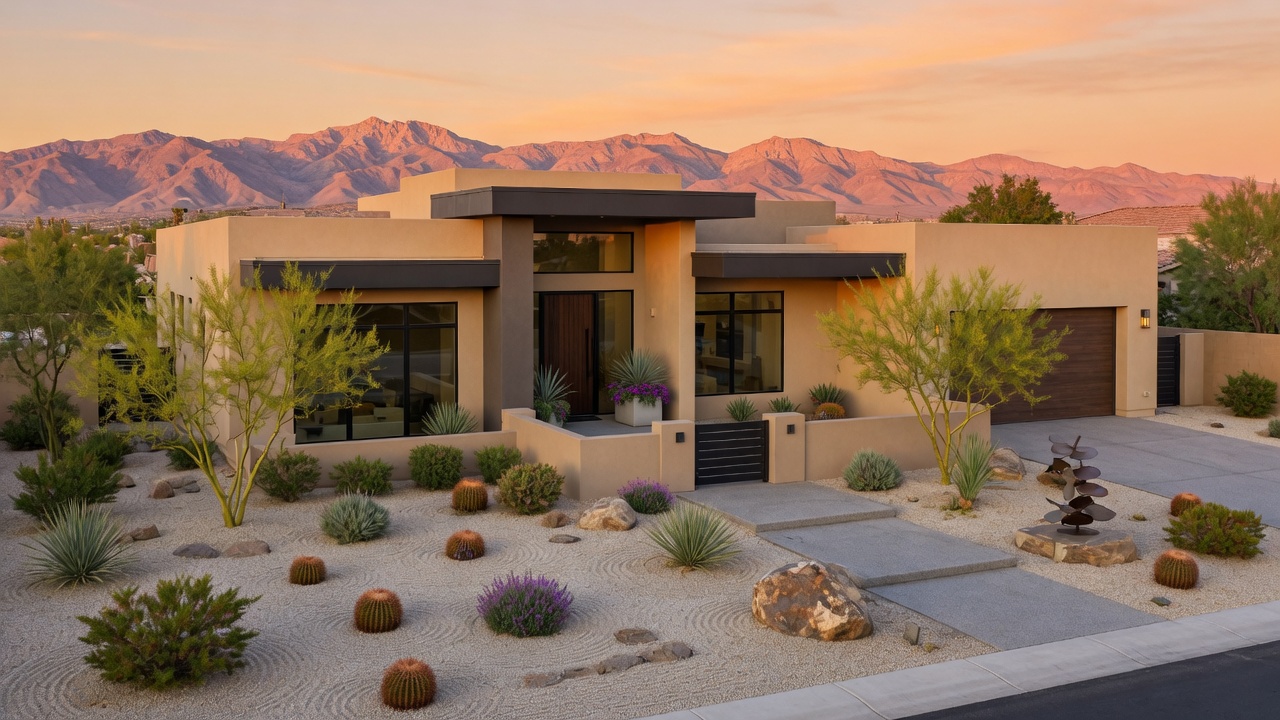
The most effective curb appeal investments for Las Vegas sellers are straightforward. Pressure washing the driveway, walkways, and exterior walls removes the accumulated desert dust and mineral staining that makes a home look neglected. Fresh desert-adapted landscaping, including trimmed palm trees, new rock ground cover, and drought-tolerant flowering plants, signals that the home has been maintained. A coat of exterior paint on the front door and the trim around the garage costs less than $600 but changes the entire feel of the approach. Exterior lighting that works and is visible during evening showings adds a layer of perceived security that buyers respond to without consciously registering it.
Flooring Is the Single Highest-ROI Interior Investment in Las Vegas
If you can invest in only one thing before listing your Las Vegas home, replace the flooring. This is not a close call. Flooring is the largest continuous visual surface in any home, and it is the element buyers touch, walk on, and evaluate against every other home they have seen. Worn carpet, stained tile, or dated linoleum signals to buyers that the home has deferred maintenance, and that perception reduces their willingness to pay full price.
In the Las Vegas market, luxury vinyl plank flooring has become the standard for everything except primary bedrooms and formal living areas. It is waterproof, which matters in a climate where pool traffic, tile cleaning, and occasional monsoon rain mean water finds its way indoors. It is durable enough to handle the sand and dust that come with desert living. And it costs roughly $4 to $7 per square foot installed, which means a 1,800-square-foot home can have its main living areas, kitchen, hallways, and bathrooms refinished for $8,000 to $12,000.
The return on that investment is significant. In every price tier I track in Las Vegas, Henderson, and Summerlin, a home with updated flooring sells for 3 to 5 percent more than a comparable home with original or worn flooring. On a $490,000 home, that is $14,700 to $24,500 in additional sale price for a $10,000 investment. The ROI on flooring consistently runs between 150 and 250 percent within the first 30 days of listing.
Carpet replacement in bedrooms carries a similar return. A bedroom with clean, neutral, medium-pile carpet at $3 to $5 per square yard installed changes the way a buyer feels about the sleeping areas of the home. The key is keeping it neutral. Gray-beige or warm ivory carpets appeal to the broadest range of buyers.
Kitchen Updates That Move the Needle
Full kitchen remodels in Las Vegas rarely pay for themselves at sale time. A $50,000 complete kitchen renovation on a home in the $450,000 to $550,000 range typically adds $15,000 to $25,000 to the sale price. That is a negative return. Buyers in that price range expect the kitchen to function, but they are not willing to pay a premium for high-end cabinetry and commercial-grade appliances that raise the home above neighborhood comps.
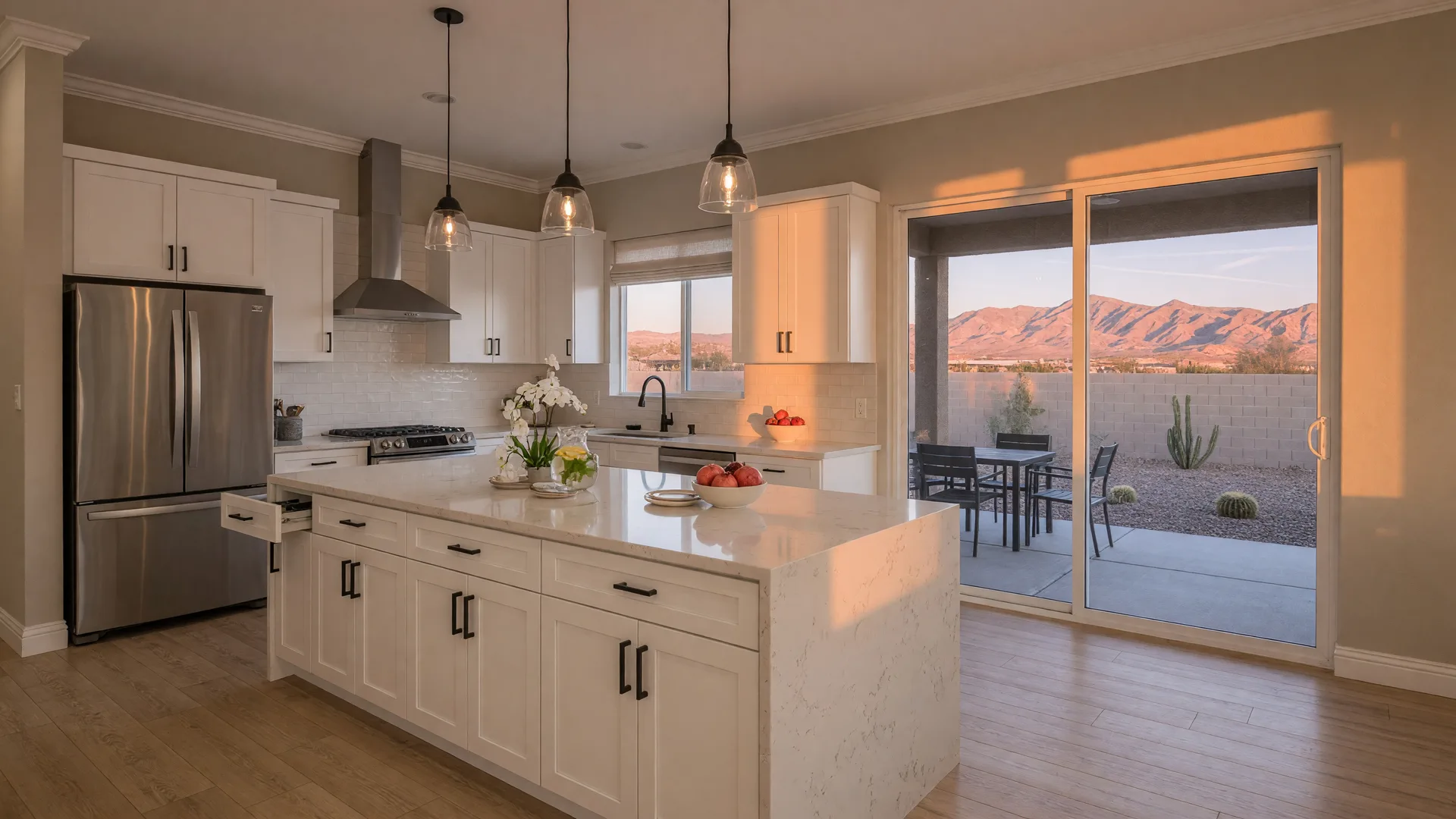
What does work is a targeted kitchen refresh. The three highest-impact investments are hardware replacement, cabinet refinishing, and countertop resurfacing or replacement. Switching out dated brass or oil-rubbed bronze hardware for matte black or brushed nickel pulls costs roughly $200 to $400 for an entire kitchen. Refinishing existing cabinets rather than replacing them costs $2,000 to $4,000 and transforms the look of the space completely. Replacing laminate or dated tile countertops with quartz costs $4,000 to $6,000 for a typical Las Vegas kitchen and is the single most visible upgrade a buyer will notice within the first five seconds of entering the room.
The total investment for these three updates runs $6,500 to $10,500, and I consistently see a return of 80 to 120 percent on that spend in the form of faster offers and prices closer to asking. The kitchen does not need to win a design award. It needs to look clean, current, and well-maintained. That is where the value is.
The Two Mechanicals That Scare Buyers Most
In 30 years of Las Vegas real estate, there are two systems that kill more deals than any staging mistake or pricing error: the HVAC system and the water heater. Both are invisible to buyers during normal tours, but both will be discovered during the inspection, and both become instant negotiation leverage for the buyer.
Las Vegas HVAC systems operate under extreme conditions. Air conditioning units that work well in milder climates fail faster here because they run at capacity for six to eight months of the year. A typical residential HVAC unit lasts 10 to 12 years in Las Vegas, compared to 15 to 20 years in temperate regions. If your AC unit is over 10 years old, every buyer's inspector will flag its age and expected remaining lifespan, and the buyer will request a credit or replacement. You will either negotiate that credit at a time of the buyer's choosing or address it proactively before listing.
Proactive replacement of an aging HVAC system costs $5,000 to $8,500 for a typical single-family home in Las Vegas. That is a significant investment. But here is the math: a buyer who sees a new HVAC system in the disclosure package factors that into their offer at a premium of roughly 60 to 80 percent of the replacement cost. On a $7,000 HVAC replacement, the buyer effectively adds $4,200 to $5,600 to their offer price because they know they will not have to replace it themselves. More importantly, they remove the HVAC-related inspection contingency, which shortens the negotiation timeline and reduces the risk of the deal falling apart.
The water heater is a smaller but similar story. In Las Vegas, water heaters should be replaced at 8 to 10 years. A new 50-gallon gas water heater costs $800 to $1,200 installed, and a buyer who sees one under two years old in the disclosure moves on to other concerns rather than fixating on an expensive future replacement. The inspection credit they request if the water heater is old will be $800 to $1,200 anyway. Replacing it before listing removes the negotiation entirely and costs the same amount.
Paint: The Lowest-Cost, Highest-Impact Cosmetic Fix
Fresh interior paint is the renovation with the lowest absolute cost and the widest impact. A full interior repaint for a typical 1,800 to 2,200-square-foot Las Vegas home runs $2,500 to $4,500 depending on ceiling height and wall condition. The effect on buyer perception is immediate and disproportionate to the cost.
Buyers associate fresh paint with a well-maintained home. They may not verbalize it, but a freshly painted interior in a neutral warm tone reduces the mental list of "things I need to fix after I move in." Every item on that list reduces the price a buyer is willing to offer. Removing the single most visible and irritating item by painting costs less than most buyers would spend on a weekend of painting themselves, and the time savings alone justify the expense.
The color choice matters. In Las Vegas, the most broadly appealing interior colors are warm off-whites, light greiges, and soft beiges that complement the natural desert light. Cool grays that were popular five years ago have started to feel dated. Avoid bold accent walls, deep tones, or colors tied to current trends. The goal is a canvas that lets the buyer imagine their own furniture, art, and style without fighting the walls.
Renovations That Do Not Pay Off in Las Vegas
For every renovation that adds value, there is one that subtracts it. The most common value-destroying renovation I see in Las Vegas is the over-improved kitchen or bathroom in a mid-tier neighborhood. Installing $40,000 worth of custom cabinetry, waterfall-edge marble islands, and smart appliances in a home whose comps top out at $480,000 does not raise the sale price to $520,000. It makes the home the most expensive on the block, and appraisers will not support the premium because the comps do not exist. The seller recovers 40 to 60 cents on the dollar at best.
Swimming pool renovations are another area where sellers consistently lose money. Refinishing a pool surface, replacing equipment, and updating decking costs $15,000 to $30,000. A renovated pool does add value in Las Vegas — buyers expect pools in certain price tiers — but the return is typically 50 to 70 percent of the cost. If your pool is functional and clean, leave it. If it is empty, cracked, or filled with green water, filling it in or getting it operational may be a better financial choice than a full renovation depending on your timeline.
Home office conversions, wine cellars, and elaborate outdoor kitchens are the renovations most likely to be neutral or negative in resale value. These are personal choices that appeal to a narrow subset of buyers. A dedicated home office space with built-in shelving and wiring can appeal to remote workers, but converting a fourth bedroom into a permanent office reduces the bedroom count, and that is a net negative in a market where bedroom count directly influences comp valuations.
When to Renovate vs. When to Price Down
Not every home needs renovations before listing. Sometimes the smartest financial decision is to price the home to reflect its condition and let the buyer decide what they want to upgrade. This strategy works best in rising or stable markets where buyer demand is strong and inventory is limited. In the current Las Vegas market, with inventory climbing and days on market stretching, the math tilts toward renovations because buyers have alternatives.
The decision framework I use with every seller is straightforward. First, identify the renovations that remove objections rather than add features. Flooring, paint, HVAC, water heater, and curb appeal all remove objections. They answer questions that would otherwise become contingencies and price reductions. Second, measure the cost of each renovation against the likely price impact and the carrying cost of waiting. If a $6,000 flooring replacement helps you sell 20 days faster and at $10,000 above what you would get without it, the renovation is an investment, not an expense.
Third, consider your neighborhood. In Summerlin, where the median home price is higher and buyers expect a turnkey condition, renovations matter more and the ROI is higher. In Centennial Hills, where first-time and move-up buyers dominate, the focus shifts to functional updates — flooring, paint, and mechanicals — rather than luxury finishes. In Henderson, where the inventory is deep and competition among sellers is intense, the best strategy is often to do the renovations that make your home stand out in photos and virtual tours, because that is where the buyer's first impression is formed.
A Practical Renovation Budget
For most Las Vegas homes in the $400,000 to $600,000 range, a pre-listing renovation budget of $10,000 to $18,000 is enough to cover the highest-impact updates. Here is where I would allocate it.
$2,500 to $4,500: Interior paint in a warm neutral throughout all living areas, hallways, and bedrooms. $3,000 to $5,000: Flooring replacement in the main living areas, kitchen, and hallways with luxury vinyl plank. $1,500 to $3,000: Carpet replacement in bedrooms. $1,000 to $2,500: Curb appeal: pressure washing, fresh rock ground cover, front door paint, exterior lighting. $1,500 to $3,000: Kitchen refresh: hardware, cabinet refinishing, and countertop resurfacing. $500 to $1,000: Light fixture updates in the entry, kitchen, and primary bathroom.
This $10,000 to $18,000 investment consistently generates $20,000 to $40,000 in additional sale price and reduces days on market by 20 to 40 percent. In a market where the average home sits for 55 days, cutting that to 35 days saves you $2,500 to $3,500 in carrying costs alone, and that is before accounting for the price premium.
The Bottom Line
Pre-listing renovations in Las Vegas are not about making your home look like a showroom. They are about removing the reasons a buyer would say no. Every objection you eliminate before listing is a negotiation you do not have to have at the inspection table. Every dollar you spend on flooring, paint, mechanically functional systems, and curb appeal is a dollar that comes back to you in a faster sale and a stronger price.
The sellers who win in this market are the ones who understand that preparation is a competitive advantage. They do not wait for a buyer to ask for a credit. They remove the reason for the credit before the home ever hits the market. That is the strategy that has worked for the last 30 years in Las Vegas, and it is the strategy that works today.
If you are preparing to sell your Las Vegas home and want a clear-eyed assessment of which renovations will actually pay off in your specific neighborhood and price tier, I can help. I have walked through hundreds of homes with this exact question, and the answer always depends on the comps, the condition, and the market timing. I will give you the honest answer, even when it means spending less than you planned.
Over 30 years of Las Vegas real estate experience. Master Certification in Negotiation. Strategic partnerships with Zillow, HomeLight, Veterans United, Google, and Dave Ramsey's referral network.
Full Bio
Not sure what to renovate before selling?
Javier provides a free pre-listing walkthrough with a renovation roadmap tailored to your home, neighborhood, and price tier.
Schedule Your Walkthrough