Las Vegas Luxury Home Prices Are Rising 16%: Here Is Why That Is Not the Full Story

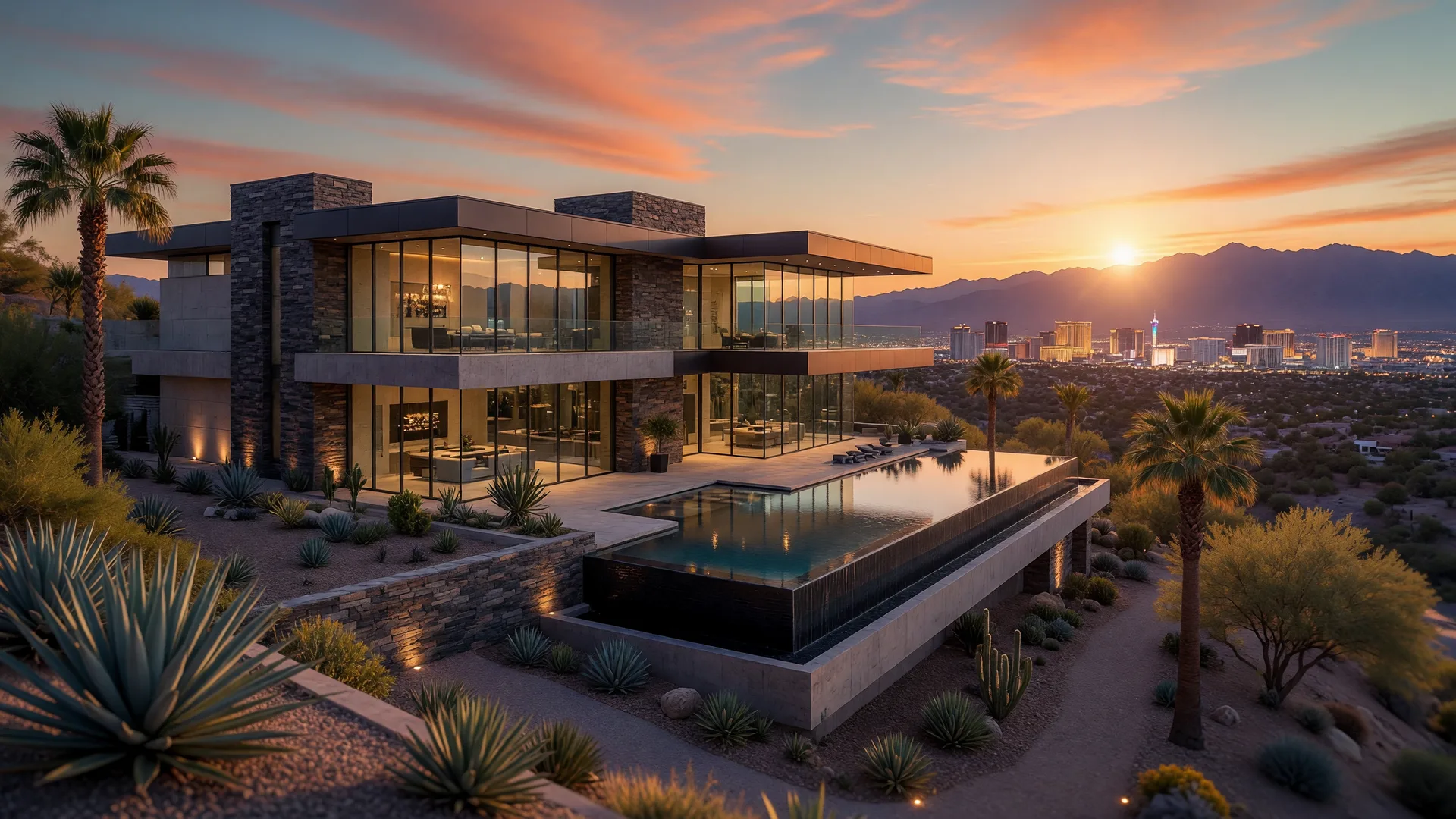
Las Vegas luxury home prices are rising faster than nearly anywhere else in the country. According to a July 2026 report from Redfin, the valley ranked second nationally for year-over-year luxury price appreciation at 16.1%, trailing only Tampa. That headline sounds like a nonstop rocket ship, but anyone working this market daily knows the full picture is more complex and far more interesting than a single statistic.
Let me start with the honest assessment. The Las Vegas luxury segment is experiencing a paradox that I have not seen in my three decades in this business: prices are climbing at double-digit rates while inventory sits at levels we have not seen since before the pandemic. That contradiction is creating confusion for buyers and sellers alike. Depending on which data point you cite, you can make a case that the market is either booming or stalling. Both perspectives contain truth, and neither tells the complete story.
The Headwinds: Where the Market Is Actually Softening
Before I explain why I am bullish on Las Vegas luxury, I owe you the unvarnished version of what is happening on the ground. Here are the headwinds I am tracking every week:
- Inventory at a multi-year high. The luxury market carried 4.8 months of supply in May 2026 with 312 active listings above $1 million, the highest May count since 2023. New construction deliveries in master-planned communities are driving much of that increase, and the pipeline shows no sign of slowing.
- Prolonged days on market for mispriced listings. While correctly priced properties move quickly, the average days on market for luxury homes that miss their price target stretches well past 60 days. I am seeing listings accumulate market stigma after two or three incremental price drops, making them harder to revive than to replace.
- Segmentation at the entry-level luxury tier. The $1 million to $1.5 million range is the most competitive segment, where new construction supply overlaps most heavily with resale inventory. Buyers in this bracket have genuine negotiating leverage, and sellers who do not price aggressively from day one are watching their homes sit.
- Buyer selectivity has returned. The pandemic-era urgency is gone. Luxury buyers today tour multiple properties, compare finishes and lot values, and are not afraid to walk away from a deal that does not meet their terms. That is healthy for the market, but it creates friction for sellers who expected a quick, full-price transaction.
These are real forces. They matter. But they are only half of the equation.
The Pivot: Why the 16% Appreciation Rate Is More Than a Headline
Here is where the data gets interesting. The same market that carries elevated inventory is also producing price appreciation that outpaces virtually every other major U.S. metro. The luxury segment is appreciating at 16.1% year-over-year, which is nearly 57% faster than the valley-wide average of 3.7%. That spread tells us something structural is happening at the high end of the market, not just a cyclical bump.
Consider what drove the first half of 2026. In Q1 alone, luxury closed sales above $1 million hit 412 transactions, an 18% increase over the same period in 2025. The average luxury sale price reached $2.1 million. Fourteen homes sold above $5 million in the quarter. The full-year 2025 tally was roughly 2,462 luxury closings, a 13.6% jump from 2024. The trajectory is unmistakably upward.
How do prices rise 16% while inventory also rises? The answer lies in the composition of demand. The luxury buyer pool in Las Vegas has shifted structurally over the past three years, and that shift is accelerating.
California Wealth Migration Is Not Slowing Down
The single most powerful force driving Las Vegas luxury appreciation is out-of-state wealth migration, with California accounting for an estimated 35% of luxury purchases. These buyers are not relocating for the weather or the nightlife. They are moving for a hard financial calculation: no state income tax, lower property taxes, and significantly more home for the dollar compared to coastal California markets.
A $2 million budget in San Diego buys a modest three-bedroom. In Summerlin or MacDonald Highlands, that same budget buys a custom-built estate on a half-acre lot with mountain views, a pool, and a three-car garage. The value proposition is undeniable, and high-net-worth Californians are voting with their checkbooks.
Crucially, these buyers are largely immune to mortgage rate movements. Cash purchases account for 62% of luxury transactions in Las Vegas, insulating the segment from the interest rate sensitivity that plagues the sub-$750K market. When your buyer does not need a loan, a 6.5% or 7% rate is irrelevant. That structural cash advantage is why luxury prices have continued climbing while the broader market has flattened.
Summerlin and Henderson: The Two Engines of Luxury Growth
Not all Las Vegas luxury is created equal. The appreciation is concentrated in specific submarkets with characteristics that attract premium buyers.
Summerlin continues to lead the valley in luxury price growth at 5.8% year-over-year, driven by trophy enclaves like The Ridges, The Summit Club, and the new Ascension development. These communities offer gated security, golf course access, and proximity to Red Rock Canyon that no other part of the valley can replicate. Summerlin luxury listings that are priced correctly and presented well are still generating multiple offers in the first 30 days.
Henderson is the story that keeps getting more interesting. MacDonald Highlands, Ascaya, and Anthem are seeing sustained demand from both California relocators and local move-up buyers. The $1.3 billion Four Seasons Private Residences project in Henderson has put a spotlight on the city's luxury potential, with units priced up to $27.5 million redefining what Las Vegas ultra-luxury looks like. Lake Las Vegas continues to attract a distinct buyer who wants waterfront living in the desert, a combination you cannot find anywhere else in the Southwest.
The buyers targeting these communities are not price-shopping. They are lifestyle-shopping. And that distinction is why the 16% appreciation figure carries more weight than the inventory statistic.
Why the Inventory Surge Is a Feature, Not a Bug
I want to reframe the inventory story because I think it is being misunderstood in the broader narrative. A 4.8-month supply of luxury homes is not a warning sign. It is a return to normalcy after years of artificially constrained supply.
From 2021 through 2023, luxury inventory in Las Vegas hovered between 1.5 and 2.5 months of supply, which was historically abnormal for the high end. Luxury homes are not meant to trade like consumer commodities. They require time for the right buyer to discover them, tour them, and make an informed decision. A market with 6+ months of luxury supply would signal genuine oversupply. At 4.8 months, we are still in balanced territory with a slight tilt toward sellers in premium locations.
The inventory increase is also concentrated in the types of properties that benefit most from buyer choice. New construction luxury homes in master-planned communities now compete directly with resale inventory in the same neighborhoods, and that competition is actually healthy. It forces sellers to differentiate on price, condition, and location rather than relying on scarcity to drive demand. Buyers get better value. Sellers who adapt win.
What This Means for Buyers
If you are a luxury buyer in today's Las Vegas market, the combination of rising prices and elevated inventory creates a narrow window that requires precise execution. Here is how to approach it:
- Target listings in the 30-to-60 day range. These are homes where the seller is starting to recognize that their initial price may have been aspirational. They are often open to offers within 5% of list, especially if you bring clean terms and strong earnest money.
- Focus on Summerlin and Henderson's premium enclaves. The 16% appreciation is being driven by these areas. Buying in a location with structural demand advantages gives you long-term equity protection regardless of where the broader market moves.
- Do not wait for a broad price drop. The data does not support it. With cash at 62% of transactions and California migration continuing, the ceiling on luxury prices is higher than many expect. The best strategy is to buy at fair market value in a location with proven appreciation and hold through the cycle.
What This Means for Sellers
For luxury sellers, the message is the same as it has been all year, only more urgent: the first 30 days are everything. A luxury home priced within 2% of market equilibrium in Summerlin or Henderson will generate showing activity, create momentum, and often sell within that window. A home priced 5% to 10% above the market will sit, and every day it sits erodes your negotiating position.
There is no substitute for accurate pricing and a professional presentation. With my strategic partnerships including Zillow, HomeLight, Veterans United, Google, and the Dave Ramsey referral network, I can expose a luxury listing to over 42 million potential buyers. But even the most aggressive marketing cannot sell a home that the market perceives as overpriced. Price is the single most important variable in this equation, and it is the one sellers control completely.
The Bottom Line
The Las Vegas luxury market is not a simple story. It is rising 16% in price and carrying more inventory than it has in years, and both of those things are true at the same time. That paradox does not mean the market is confused. It means the market is segmenting: trophy properties in premium locations with correct pricing are thriving, while standard luxury homes in high-inventory subdivisions face genuine competition.
For buyers, the opportunity is in recognizing that inventory gives you choice, but appreciation tells you the market is not waiting. For sellers, the opportunity is in pricing aggressively and presenting professionally to capture the strong demand that still exists for the right property at the right price.
In three decades of Las Vegas real estate, I have learned that the best deals are made when the narrative is complicated. When everyone agrees on a market, the opportunity has already passed. Right now, the luxury market is complicated in exactly the right ways, and the people who understand the full picture will be the ones who come out ahead.
If you are considering a luxury purchase or sale in Las Vegas, Henderson, or Summerlin and want a strategy built on real data rather than headlines, I am available for a no-obligation consultation. Call me, email me, or schedule a time to talk.
Target Keywords
Platform-Specific Meta Variations (For Cross-Posting)
For Agent Image / WordPress (tmtluxury.com)
Goal: Avoid duplicate SEO content penalties on non-Halo sites
- Alternate Meta Title: Las Vegas Luxury Home Prices Surge 16% Despite Record Inventory
- Alternate Meta Description: Las Vegas luxury prices are up 16% year-over-year even as inventory hits multi-year highs. Here is how Summerlin and Henderson buyers can navigate the paradox.
- Alternate URL Slug Suggestion:
/las-vegas-luxury-price-surge-inventory-paradox
For Lofty CRM
Goal: Keep titles short and punchy for email newsletter click-throughs
- Alternate Meta Title: Vegas Luxury Prices Up 16%, But Here Is the Catch
- Alternate Meta Description: Luxury home prices are climbing fast in Las Vegas. What rising inventory means for buyers and sellers right now.
- Alternate URL Slug Suggestion:
/vegas-luxury-prices-inventory
Over 30 years of Las Vegas real estate experience. Master Certification in Negotiation. Strategic partnerships with Zillow, HomeLight, Veterans United, Google, and Dave Ramsey's referral network.
Full Bio
Ready to navigate the luxury paradox?
Javier brings 30+ years of market expertise, a Master Certification in Negotiation, and a buyer reach of 42 million to every transaction.
Schedule a Consultation