Las Vegas Homebuilder Sales Slump — But Prices Stay High. Here's Why.

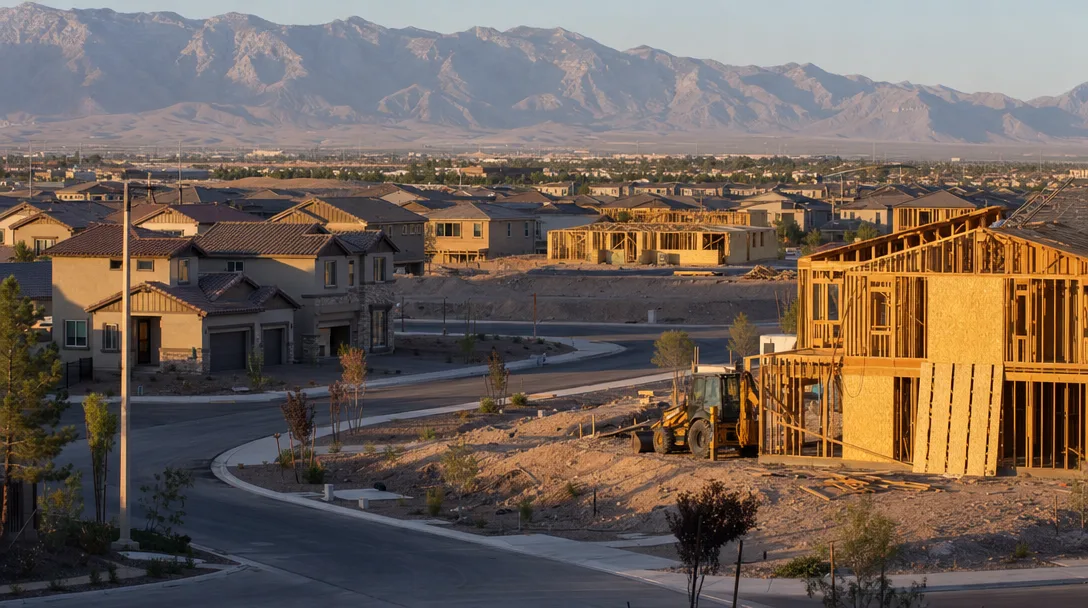
The latest Las Vegas Review-Journal report on homebuilder activity through June 2026 tells a story that looks contradictory at first glance: new home sales in Southern Nevada have dropped sharply compared to last year, yet the median sale price remains stubbornly high. Through the first half of 2026, builders recorded just 4,284 net home sales across the valley — a significant decline from the 2025 pace that had many analysts projecting a strong year. The headline reads like a market in trouble. The reality is more nuanced, and for buyers and sellers who understand the numbers, the picture ahead is far more encouraging than the raw sales figures suggest.
What is happening in the Las Vegas new home market is not a collapse in demand. It is a collision between elevated borrowing costs, persistent price growth, and a fundamental shift in what buyers can afford. The market is recalibrating. And in that recalibration lies opportunity — for the patient buyer, the strategic seller, and the investor willing to look past the monthly headlines.
What the Numbers Actually Say
The 4,284 net sales through June represents a year-over-year decline that has builders reassessing their construction timelines and pricing strategies. The drop is concentrated in the entry-level and move-up segments, precisely where rising mortgage rates hit hardest. When a family's monthly payment on a $475,000 home went up by roughly $300 to $400 per month compared to two years ago, the math shifts. Some buyers are priced out entirely. Others are waiting on the sidelines for rates to drop or prices to cool.
But here is the critical detail that the headline numbers obscure: the median new home price in Southern Nevada has not fallen. It remains elevated at approximately $495,000, essentially flat year-over-year after adjusting for mix. Builders are not cutting prices aggressively. Instead, they are shifting their strategy in three specific ways that every buyer and seller in Las Vegas, Henderson, Summerlin, and Centennial Hills should understand.
Strategy One: Incentives Over Price Cuts
One of the most instructive trends in the current market is how builders are responding to slower sales. They are not slashing base prices — doing so would devalue existing inventory, trigger price renegotiations from buyers under contract, and signal weakness in a market where land and material costs remain high. Instead, builders are investing heavily in incentives that lower the buyer's true cost without touching the published price tag.
Rate buydowns are the dominant tool in 2026. A typical builder incentive program today includes a temporary 2-1 buydown that reduces the first-year mortgage rate by 2 percent and the second-year rate by 1 percent before settling at the note rate for years three through thirty. On a $400,000 loan, that translates to monthly savings of roughly $475 in year one and $240 in year two. For a buyer who plans to refinance when rates drop — and most of them do — these buydowns bridge the gap between today's cost barrier and tomorrow's lower payment.
Closing cost credits, free upgrades, and landscaping packages are also common. Some builders are offering $15,000 to $30,000 in total concessions on base-priced homes, which effectively offsets the cost of rate buydowns or reduces the cash needed at closing. The value is real, but it requires buyers to understand what they are getting and to compare total cost of ownership — not just the list price — across communities.
Strategy Two: Right-Sizing Construction Pipelines
The sales slowdown has triggered a parallel response in supply. Builders are pulling back on starts, reducing the number of new homes entering the pipeline to match the current pace of demand. This is the same rational market behavior we saw during the 2022 rate shock, and it has the same long-term implication: less supply now means less competition and more pricing power for existing inventory later.
The apartment construction pipeline is following the same pattern. The Las Vegas Review-Journal reported on July 22 that the multifamily construction pipeline has fallen to its lowest level in four years, with the valley on track to add only 3,400 new apartment units this year. For context, the valley was adding more than twice that annually during the 2021-2023 building boom. The slowdown in multifamily construction will tighten rental supply, which historically pushes more tenants toward homeownership as rents rise and the price-to-rent ratio shifts in favor of buying.
For homeowners and sellers, the pullback in new supply is good news. Every new home that does not get built is one fewer competitor for your property in the resale market. And every apartment that does not get built puts upward pressure on the rental demand that eventually feeds into the for-sale market.
Strategy Three: Targeting the Luxury and Active-Adult Segments
While entry-level and move-up sales have softened, the luxury and active-adult segments in Las Vegas remain surprisingly resilient. Las Vegas luxury home prices are rising faster than almost any other market in the United States — trailing only Tampa and Miami in price growth according to a mid-July report. The combination of California wealth migration, low inventory in the premium segment, and the lifestyle appeal of Las Vegas luxury communities in Summerlin, Henderson, and Southern Highlands is driving competition at the top of the market.
Active-adult communities — 55-plus developments targeting retirees and empty-nesters — are also outperforming the broader market. The demographic tailwind here is powerful: approximately 10,000 baby boomers turn 65 every day in the United States, and Nevada's combination of no state income tax, warm climate, and relatively lower cost of living makes it a primary destination for this cohort. Builders who have pivoted to active-adult product are seeing steady traffic and conversion rates that their entry-level peers envy.
The Job Growth Factor: Why Demand Will Return
The most important context for the homebuilder sales data is the broader Las Vegas economy. Nevada continues to lead the nation in job growth, adding 34,500 positions year-over-year through April 2026. The Las Vegas metro alone accounted for 19,600 of those new jobs, and the growth is spreading beyond hospitality into tech, healthcare, construction, and logistics. The Las Vegas Review-Journal reported on July 16 that the region added thousands of jobs in June as tourism levels improved, with notable gains in leisure and hospitality, professional services, and construction.
A growing job market creates housing demand. It is not always instantaneous — it takes time for new residents to save a down payment, establish credit, and decide to buy — but the relationship between employment growth and home sales is one of the most reliable correlations in real estate economics. The jobs are here. The people are moving here — Las Vegas was ranked the fifth most searched housing market in the nation by Redfin in Q1 2026, and California buyers generated nearly a third of all out-of-market search traffic. The demand is accumulating. It is waiting for the rate environment to cooperate, and then it will convert.
Prices Stay High: Why the Market Is Not Crashing
Every market cycle produces a chorus of voices predicting a crash. The current cycle is no different. But the data does not support a crash scenario for Las Vegas. Here is why.
First, inventory remains below long-term equilibrium. While active listings have risen to approximately 7,100 homes across the valley, that is roughly a 3.6-month supply — still below the 5-to-6-month range that defines a balanced market. Inventory is higher than it was, but it is not oversupplied.
Second, homeowners have record levels of equity. The vast majority of Las Vegas homeowners who purchased before 2023 have substantial tappable equity, which means distressed sales remain at historically low levels. Foreclosure activity has ticked up slightly from the near-zero levels of 2021-2023, but it is still a fraction of what we saw during the 2008-2012 period. There is no forced-selling wave coming to flood the market with inventory.
Third, the demand side of the equation is structurally strong. Population growth, job creation, California migration, and lifestyle demand all support the long-term trajectory of Las Vegas home values. Short-term price fluctuations driven by interest rate movements do not change the fundamental math of a market that is adding residents faster than it is adding homes.
What This Means for Buyers Right Now
For buyers in Las Vegas, Henderson, Summerlin, and Centennial Hills, the current market conditions represent a window that will not stay open indefinitely. The combination of higher inventory, builder incentives, and motivated resale sellers creates a negotiating environment that did not exist in 2023 or 2024.
If you are buying in the new home market, the incentives available today are the deepest I have seen since the 2022 rate shock. Rate buydowns, closing cost credits, and upgrade packages worth tens of thousands of dollars are on the table — but only for buyers who are qualified, ready, and willing to commit. Builders are not offering these incentives to window shoppers. They are offering them to buyers who can close.
If you are buying in the resale market, the dynamic is similar but requires more negotiation skill. Sellers who need to move — whether for a job relocation, life change, or because they bought in 2021-2022 and are ready to trade up — are increasingly open to seller concessions, rate buydown contributions, and price adjustments. The key is working with an agent who understands the comps, the inventory trends in your target neighborhood, and the specific leverage points available in each negotiation.
What This Means for Sellers
For sellers, the takeaway is straightforward but requires disciplined execution. The market is not crashing, but it is more competitive than it was a year ago. Your property is competing not only with other resale listings but with builder incentives that can make new construction artificially attractive on a monthly payment basis.
The winning strategy in this environment is threefold. Price realistically from day one — the days of pricing high and waiting for a lowball to negotiate up from are over in most submarkets. Present aggressively: professional photography, staging, and a marketing plan that reaches the out-of-state buyer pool are non-negotiable. And be prepared to offer concessions that bridge the gap between your price and the buyer's monthly payment comfort zone — whether that means a rate buydown contribution, closing cost assistance, or a home warranty package.
My partnerships with Zillow, HomeLight, Veterans United, Google, and Dave Ramsey's referral network give my sellers access to a buyer audience of over 42 million. Combined with my database of 32,000 qualified buyers, that reach is specifically designed to perform in markets like this one, where the buyers are out there but need the right motivation and the right financing support to act.
The Bottom Line: A Market in Transition, Not Decline
The Las Vegas new home market is not in trouble. It is in transition. Homebuilder sales are down, but prices are stable. Construction pipelines are shrinking, but that means future supply will be tighter. Incentives are generous, but that benefits buyers who are ready to move. And the long-term demand drivers — job growth, population growth, migration from high-cost states, and a diversifying economy — remain as strong as they have been at any point in my 30-year career in this market.
The homebuilders' response to slower sales is a textbook case of rational market adjustment. They are not panicking. They are not flooding the market with distressed inventory. They are managing supply, pivoting to the segments that work, and using incentives to meet buyers where they are. Sellers and buyers should take the same approach: understand the conditions, adjust your strategy, and move when the opportunity aligns with your goals.
Las Vegas is still one of the fastest-growing metropolitan areas in the United States. The short-term headlines about sales volume do not change the long-term trajectory. If you are thinking about buying, selling, or investing in Las Vegas real estate, now is the time to have an informed conversation about what these trends mean for your specific situation. I am available for a no-obligation consultation to help you make sense of the numbers and build a plan that works for your timeline and your budget.
For Agent Image / WordPress (tmtluxury.com)
New Home Sales Slow in Las Vegas — But Here Is the Opportunity Buyers Are Missing
Las Vegas homebuilder sales dropped through June 2026, yet median prices held firm. Builders are offering deep incentives. What it means for you.
/las-vegas-new-home-sales-slow-2026-opportunity
Alternative phrasing and slug prevent duplicate SEO penalties when cross-posted to tmtluxury.com.
For Lofty CRM
Home Sales Dip in Vegas — But Prices Aren't Falling
New home sales are down in Las Vegas. Prices are not. Builders are offering major incentives. Here is the full picture.
/vegas-home-sales-dip-prices-hold
Shorter title and description optimized for email drip readability and Lofty blog formatting.
Over 30 years of Las Vegas real estate experience. Master Certification in Negotiation. Strategic partnerships with Zillow, HomeLight, Veterans United, Google, and Dave Ramsey's referral network.
Full Bio
Market moving fast. Strategy should too.
Whether you are buying, selling, or investing, Javier provides the data, perspective, and reach to navigate today's Las Vegas market with confidence.
Schedule a Consultation